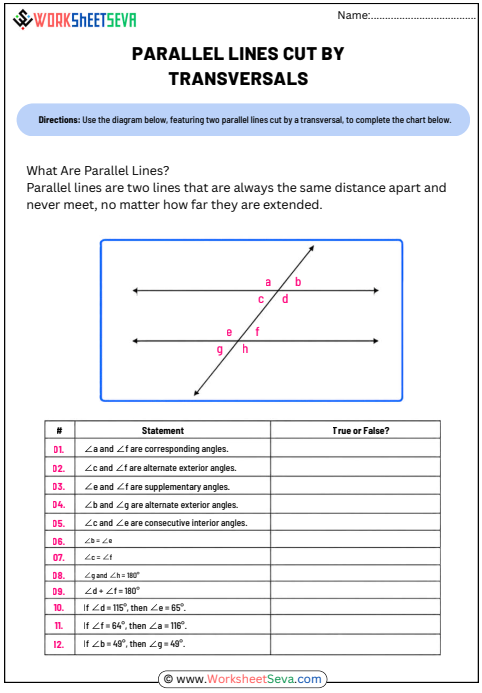
A parallel lines cut by a transversal worksheet helps middle school students understand one of the most important geometry concepts: the relationships between angles formed when a transversal intersects two parallel lines. These worksheets provide structured practice with identifying angle pairs, solving for missing angle measures, and applying geometric reasoning to real-world situations.
Whether students are learning the basics or working on parallel lines cut by a transversal worksheet solving equations, these activities reinforce classroom instruction while building confidence in geometry.
What This Worksheet Contains
This printable worksheet is designed for students in Grades 6–8 and includes a variety of engaging activities that develop both conceptual understanding and problem-solving skills.
Students will practice:
- Identifying corresponding angles
- Recognizing alternate interior angles
- Recognizing alternate exterior angles
- Finding same-side (consecutive) interior angles
- Identifying vertical angles
- Solving for unknown angle measures
- Determining True or False angle relationships
- Using algebra to solve missing angle equations
- Applying geometry vocabulary correctly
The worksheet combines diagrams, critical thinking questions, and equation-based practice to support comprehensive learning.
Key Topics CoveredUnderstanding Parallel Lines
Students learn that parallel lines remain the same distance apart and never intersect.
What Is a Transversal?
A transversal is a line that crosses two or more lines, creating multiple pairs of related angles.
Angle Relationships
The worksheet focuses on these essential geometry concepts:
| Angle Relationship | Property |
|---|---|
| Corresponding Angles | Equal |
| Alternate Interior Angles | Equal |
| Alternate Exterior Angles | Equal |
| Vertical Angles | Equal |
| Same-Side Interior Angles | Supplementary (180°) |
| Linear Pair | Sum equals 180° |
Identifying Angle Pairs
Students examine diagrams and identify various angle relationships based on their positions.
Activities encourage learners to:
- Match angle pairs
- Label missing angles
- Compare angle positions
- Explain their reasoning
Solving Missing Angles
Students use known angle relationships to determine unknown angle measures.
Example problems include:
- Finding corresponding angles
- Using supplementary angles
- Applying vertical angle relationships
- Solving multi-step angle problems
Parallel Lines Cut by a Transversal Worksheet Solving Equations
As students advance, they solve algebraic equations involving angle expressions.
Example:
If corresponding angles are equal:
- ∠1 = (3x + 12)°
- ∠5 = (5x − 6)°
Since corresponding angles are congruent:
3x + 12 = 5x − 6
Students solve for x and then determine each angle measure.
These equation-based problems connect geometry with algebra and strengthen mathematical reasoning.
Learning Outcomes
After completing this worksheet, students will be able to:
- Explain what parallel lines and transversals are.
- Identify corresponding, alternate interior, alternate exterior, vertical, and same-side interior angles.
- Determine whether angle statements are true or false.
- Solve missing angle measures using angle relationships.
- Apply supplementary and congruent angle properties.
- Solve algebraic equations involving unknown angles.
- Use mathematical vocabulary accurately.
- Develop logical reasoning and geometric thinking.