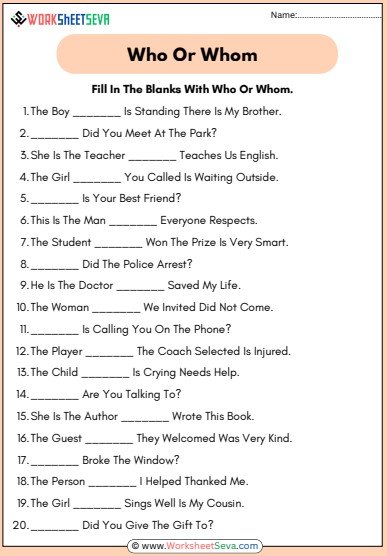
Learning the correct use of “who” and “whom” is an important grammar skill. Many students get confused because these words look similar, but they are used differently. This worksheet helps you understand the difference through simple sentences using familiar words like teacher, friend, and doctor.
What Is the Difference?
“Who” and “whom” are used to ask questions or give details about people. The main difference lies in whether the person is doing the action or receiving the action.
1. When to Use “Who”
Use “who” when you are talking about the person performing the action. In grammar terms, this is the subject.
- Rule: If the person is doing something, use “who.”
- The He/She Test: If you can replace the word with “he,” “she,” or “they,” then “who” is the correct choice.
- Examples:
- Who is calling you? (Answer: He is calling you.)
- The teacher who teaches us is kind.
2. When to Use “Whom”
Use “whom” when you are talking about the person receiving the action. In grammar terms, this is the object.
- Rule: If the action is being done to the person, use “whom.”
- The Him/Her Test: If you can replace the word with “him,” “her,” or “them,” then “whom” is the correct choice.
- Examples:
- Whom did the police arrest? (Answer: The police arrested him.)
- The girl whom you called is waiting.
Simple Trick to Remember
To decide which one to use, ask yourself if the answer involves “he” or “him.”
- If the answer is he, use who.
- If the answer is him, use whom. (Remember: they both end in m).