Learning the difference between finite and non-finite verbs is an important step in English grammar. Most students know what a verb is, but they often get confused when the verb changes its form based on the tense or the subject of the sentence.
What Are Verbs?
A verb is a word that shows:
- Action: Go, play, run
- State of Being: Is, are, was
- Happening: Singing, crying
Examples:
- She goes to school.
- The baby is crying.
However, not all verbs act the same way. Based on how they work in a sentence, they are divided into two groups:
- Finite Verbs
- Non-finite Verbs
worksheet focuses on these two concepts.
What Are Finite Verbs?
A finite verb is the main verb of a sentence. It is called “finite” because it is limited by the subject and the tense.
Key Rules for Finite Verbs:
- It changes based on the tense (past, present, future).
- It changes based on the subject (who is doing the action).
- It acts as the main verb in the sentence.
Examples:
- She goes to school. (Present tense)
- He wrote a letter. (Past tense)
- The sun rises in the east. (Singular subject)
In worksheet, words like goes, wrote, rises, and works are all finite verbs because they change depending on the time or the person.
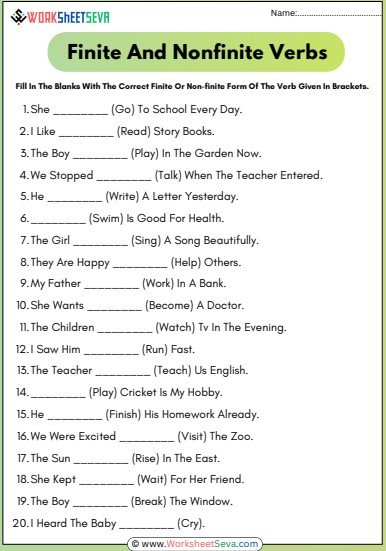
Fill In The Blanks With Finite And Nonfinite Verbs pdf answer
- She ________ (go) to school every day.
- Answer: goes Type: Finite verb Explanation: Daily habit + subject “she” → verb ends with -s.
- I like ________ (read) story books.
- Answer: reading Type: Non-finite (gerund) Explanation: “Like” is followed by verb-ing.
- The boy ________ (play) in the garden now.
- Answer: is playing Type: Finite verb Explanation: “Now” shows present continuous tense.
- We stopped ________ (talk) when the teacher entered.
- Answer: talking Type: Non-finite (gerund) Explanation: “Stopped” + verb-ing.
- He ________ (write) a letter yesterday.
- Answer: wrote Type: Finite verb Explanation: “Yesterday” → simple past tense.
- ________ (swim) is good for health.
- Answer: Swimming Type: Non-finite (gerund) Explanation: Gerund used as a noun.
- The girl ________ (sing) a song beautifully.
- Answer: sings Type: Finite verb Explanation: Third-person singular → sings.
- They are happy ________ (help) others.
- Answer: to help Type: Non-finite (infinitive) Explanation: “Happy” is followed by to + verb.
- My father ________ (work) in a bank.
- Answer: works Type: Finite verb Explanation: Habitual action.
- She wants ________ (become) a doctor.
- Answer: to become Type: Non-finite (infinitive)
- The children ________ (watch) TV in the evening.
- Answer: watch Type: Finite verb Explanation: Plural subject → base verb.
- I saw him ________ (run) fast.
- Answer: running Type: Non-finite (participle)
- The teacher ________ (teach) us English.
- Answer: teaches Type: Finite verb
- ________ (play) cricket is my hobby.
- Answer: Playing Type: Non-finite (gerund)
- He ________ (finish) his homework already.
- Answer: has finished Type: Finite verb Explanation: Present perfect tense.
- We were excited ________ (visit) the zoo.
- Answer: to visit Type: Non-finite (infinitive)
- The sun ________ (rise) in the east.
- Answer: rises Type: Finite verb Explanation: Universal truth.
- She kept ________ (wait) for her friend.
- Answer: waiting Type: Non-finite (gerund)
- The boy ________ (break) the window.
- Answer: broke Type: Finite verb Explanation: Past tense action.
- I heard the baby ________ (cry).
- Answer: crying Type: Non-finite (participle)