Coordinating conjunctions are simply connecting words. They act like glue to join words, phrases, or full sentences that are equally important. They are very common in English and are essential for clear communication.
What Are Coordinating Conjunctions?
What they connect:
- Two words
- Two phrases
- Two complete thoughts (sentences)
Examples:
- She is tired, but she is working.
- You can eat rice or roti.
How to Remember Them: FANBOYS
There are seven main connecting words. You can remember them using the word FANBOYS . This worksheet covers all of them to help students practice different sentence styles.
F – For: Explains a reason (similar to “because”).
A – And: Adds one thing to another.
N – Nor: Used for a negative choice (not this, nor that).
B – But: Shows a difference or contrast.
O – Or: Offers a choice.
Y – Yet: Shows a surprising difference (similar to “but”).
S – So: Shows a result or consequence.
Answer Key Of Coordinating Conjunctions Worksheet pdf
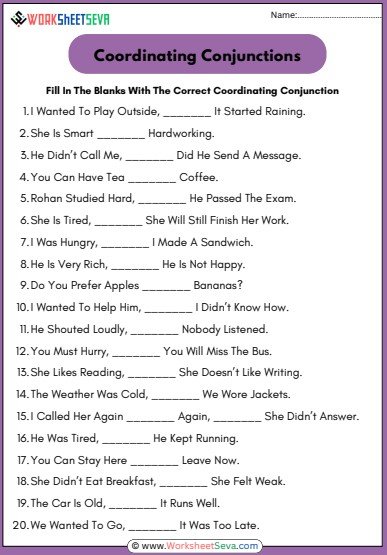
- I wanted to play outside, _ it started raining.
- Answer: but
- Contrast: wanting to play vs rain stopping it.
- She is smart _ hardworking.
- Answer: and
- Adds two positive qualities.
- He didn’t call me, _ did he send a message.
- Answer: nor Used after a negative; structure shows negative-alternative.
- You can have tea _ coffee.
- Answer: or Choice between two drinks.
- Rohan studied hard, _ he passed the exam.
- Answer: so Hard work → result → passed the exam.
- She is tired, _ she will still finish her work.
- Answer: yet Unexpected contrast (despite being tired, she works).
- I was hungry, _ I made a sandwich.
- Answer: so Reason + result.
- He is very rich, _ he is not happy.
- Answer: but Contrast between wealth and happiness.
- Do you prefer apples _ bananas?
- Answer: or Choice.
- I wanted to help him, _ I didn’t know how.
- Answer: but
- Contrast: wanting to help vs not knowing how.
- He shouted loudly, _ nobody listened.
- Answer: but Contrast.
- You must hurry, _ you will miss the bus.
- Answer: or Warning/alternative outcome.
- She likes reading, _ she doesn’t like writing.
- Answer: but Opposite preferences.
- The weather was cold, _ we wore jackets.
- Answer: so Cold weather → result → wore jackets.
- I called her again again, she didn’t answer.
- Answers: and, yet 1st blank → repetition/addition → and 2nd blank → unexpected contrast → yet
- He was tired, _ he kept running.
- Answer: yet Contrast with an unexpected continuation.
- You can stay here _ leave now.
- Answer: or Choice.
- She didn’t eat breakfast, _ she felt weak.
- Answer: so Cause → effect.
- The car is old, _ it runs well.
- Answer: but Contrast: old car vs good performance.
- We wanted to go, _ it was too late.
- Answer: but
Contrast between intention + limitation.
Common Mistakes Students Make
This worksheet helps prevent these common errors by practicing sentences that deal with choices, results, and opposites.
- Confusing “And” with “But”
Do not use “and” when you want to show a difference.
Incorrect: I was hungry, and I didn’t eat.
Correct: I was hungry, but I didn’t eat. - Using “So” for Choices
Do not use “so” when asking someone to pick between things.
Incorrect: Tea so coffee?
Correct: Tea or coffee? - Confusing “Yet” with “So”
Do not use “yet” when you need to show a result.
Incorrect: It rained, yet we stayed in.
Correct: It rained, so we stayed in.