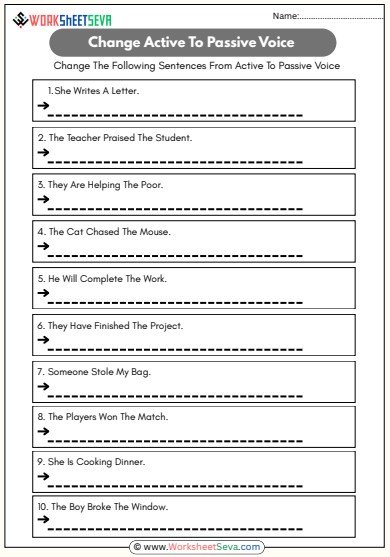
Changing the voice of a sentence—either from Active Voice to Passive Voice or Passive Voice to Active Voice—is one of the most frequently tested concepts in English grammar. Students, teachers, and competitive exam aspirants all need high-quality practice material to master this topic. That is why a detailed, concept-rich becomes extremely useful.
⭐ What Is Voice in English Grammar?
In English grammar, Voice shows whether the subject performs the action or receives the action.
1. Active Voice
Here, the subject does the action.
Example: She writes a letter.
(“She” is the doer)
2. Passive Voice
Here, the subject receives the action.
Example: A letter is written by her.
(The action is happening to “a letter”)
⭐ Why Do We Change the Voice?
- To improve clarity
- To focus on the action or the receiver
- To form formal and objective writing
- To answer grammar questions in exams
- To build strong language skills
A good Change The Voice Worksheet helps achieve all of these efficiently.
Deep Grammar Breakdown
To help your article rank well, here is an extended explanation that adds depth and keywords naturally.
Difference Between Active and Passive Voice
| Feature | Active Voice | Passive Voice |
|---|---|---|
| Focus | Doer of action | Receiver of action |
| Structure | Subject + Verb + Object | Object + Be Verb + V₃ + By + Subject |
| Tone | Direct, clear | Formal, indirect |
| Use | Daily communication | Reports, notices, official writing |
Why Passive Voice Is Important in English
- Used in scientific writing
- Makes writing formal and objective
- Helps when doer is unknown
Example: My bag was stolen. (Doer unknown)
Tense-Wise Rules Explained
1. Simple Present
Active: S + V₁ + O
Passive: O + am/is/are + V₃
2. Present Continuous
Active: S + am/is/are + V-ing + O
Passive: O + am/is/are + being + V₃
3. Simple Past
Active: S + V₂ + O
Passive: O + was/were + V₃
4. Past Continuous
Active: S + was/were + V-ing + O
Passive: O + was/were + being + V₃
5. Present Perfect
Active: S + has/have + V₃ + O
Passive: O + has/have been + V₃
6. Future Tense
Active: S + will + V₁ + O
Passive: O + will be + V₃
The Worksheet you provided is an excellent resource for mastering active and passive voice. With clear rules, multiple examples, and mixed exercises, learners can gradually strengthen their grammar foundation.